What to bring back
The things worth taking home from here are mostly edible, mostly cheap, and mostly within a short walk of each other. You do not need a souvenir shop.
Start at the Green Bazaar
Zhibek Zholy St 53 · 9am–7pm · Maps
One covered market, and almost everything on this page is inside it. Go in the morning, when the stalls are full and the sellers still have patience for questions.
- Qurt — hard, dried cheese balls. Imagine a very strong, very sharp parmesan at a tenth of the price and you are most of the way there. Read the warning at the bottom of this page before you buy any.
- Jent — a sweet pressed from roasted millet, butter and sugar. If you have already ordered a raf tary, it is the same grain in another form.
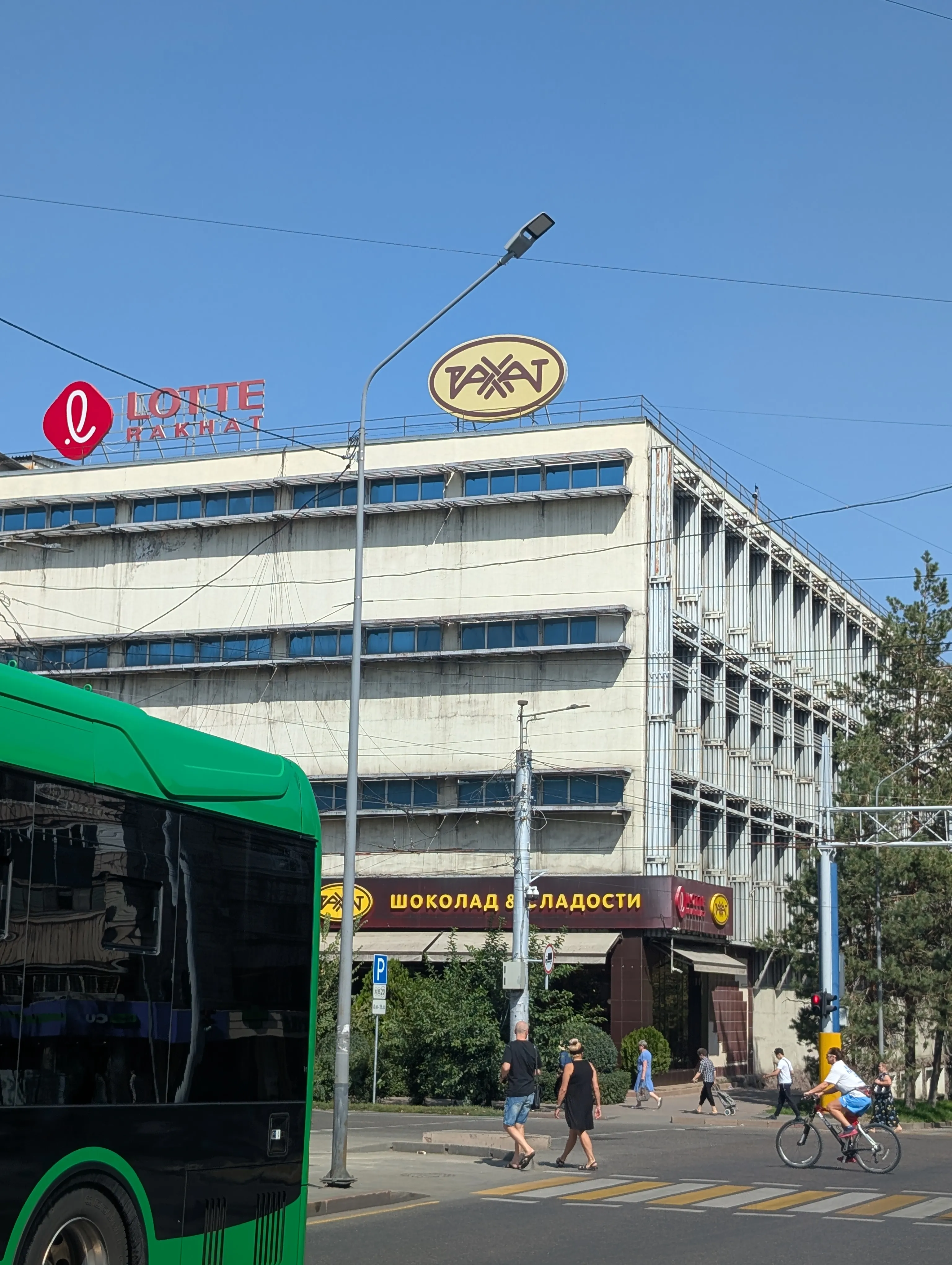
- Chocolate — ask for the bar called Kazakhstan, made by Rahat. 1,000 ₸ · ≈$2, which is the whole argument: good, and cheap enough to buy an armful. The one thing here you can hand round an office without thinking about it. The Rahat factory is directly across Zenkov Street from the market and runs two shops of its own, if you want the full range rather than whatever the stall has — its shelf prices are further down this page.
- Bazarjoq, a shop inside the market, sells chocolate made with jent in it. That combination does not exist outside this region, which makes it a better gift than plain chocolate. Its case is the photograph below, and the prices are in the paragraph under it.
And there is cheese here that is not qurt. The name to look for is Bagration, on a counter of wheels — plain, herbed, one blue-veined — with honey by the tub above it, chalk tags on those reading 1,350 and 1,600. It is not an Almaty dairy: the plant is at Proletarka in the Ulan district of East Kazakhstan, running on a creamery that goes back to 1929, so the wheels have come the better part of a thousand kilometres to reach this case. Boxed chak-chak on the same counter is 820 ₸ · ≈$1.50, and bags of baursak 420 ₸ · ≈$1 apiece, handwritten on the carton they are sold out of. The cheese is dairy, so the warning at the bottom of this page is about it too.
Bazarjoq's case is the one to go back for. What is in it is chocolate worked with the local ingredients rather than around them, boxed under the name Mirissima: toffees with balqaimaq, chocolate with jent, chocolate qurt in white cubes, and dark rounds stamped with Kazakh ornament. The tickets in the case run 4,500–6,000 ₸ · ≈$9.50–13 for 150 g — six times a plain bar, which makes this one gift rather than a stack of them.
Walk past the nuts. The spice and nut rows are the most photogenic part of the market and the most confidently priced. Cashews and walnuts are not local to anywhere — they are imported here exactly as they are imported to you — and a kilo of them is a kilo of your baggage allowance that could have been chocolate or beans. Dried fruit is dried fruit everywhere. Neither earns the space.
Two things on those rows are worth stopping for, and both are light. Loose tea, sold by weight — usually a fruit blend over green or red — which is not the sort of thing that turns up in a supermarket box at home, weighs nothing, and clears customs everywhere.
And loaded dates, stuffed with nuts. Buy those, and not as a gift: they are the best hiking food in the building, and at some point on this trip you are going up a mountain. I make my own and take them to training.
One more reason to come here: Bowler is in this building. Same street number. So the market run and the bag of locally roasted beans are a single stop rather than two.
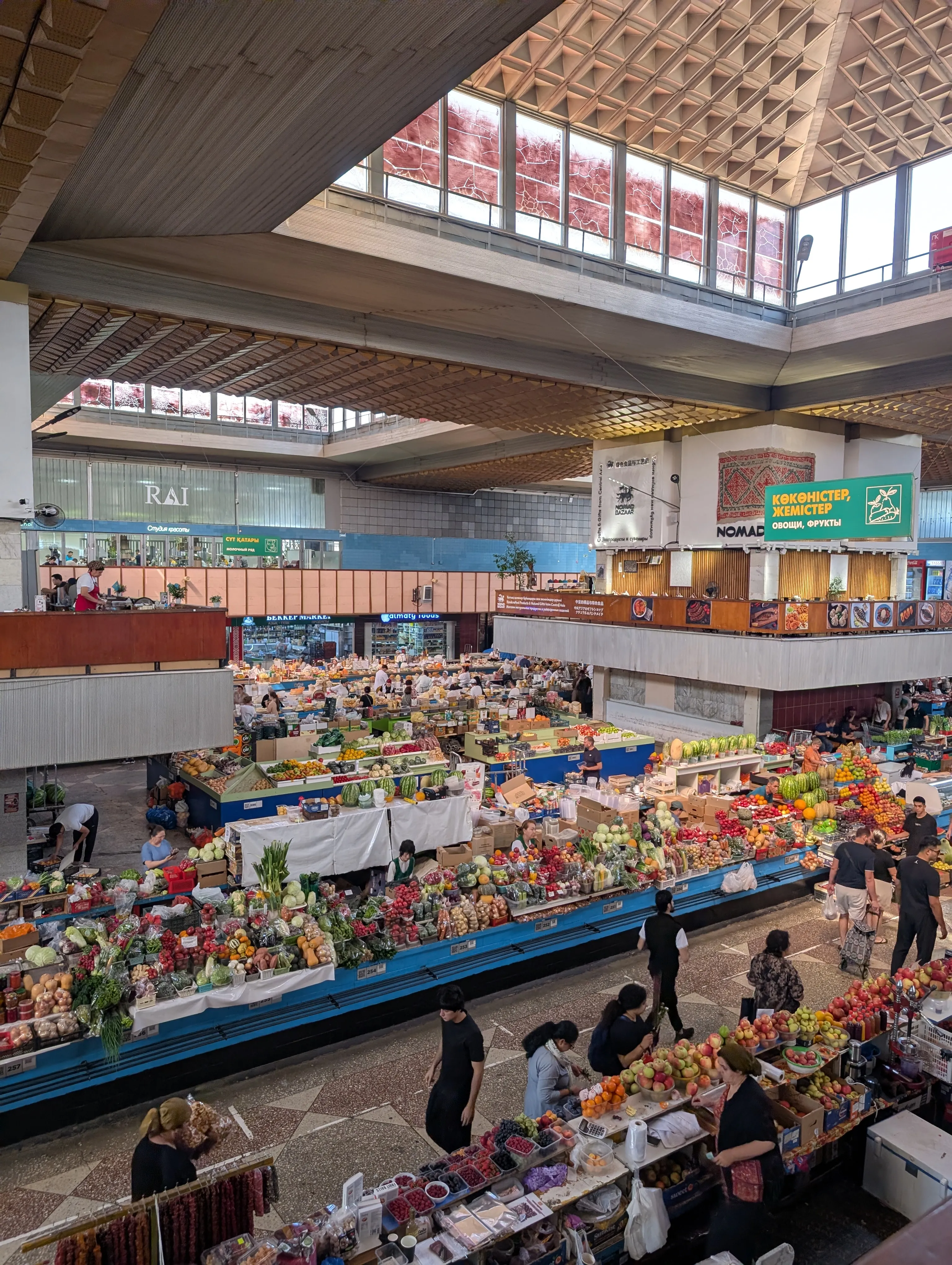
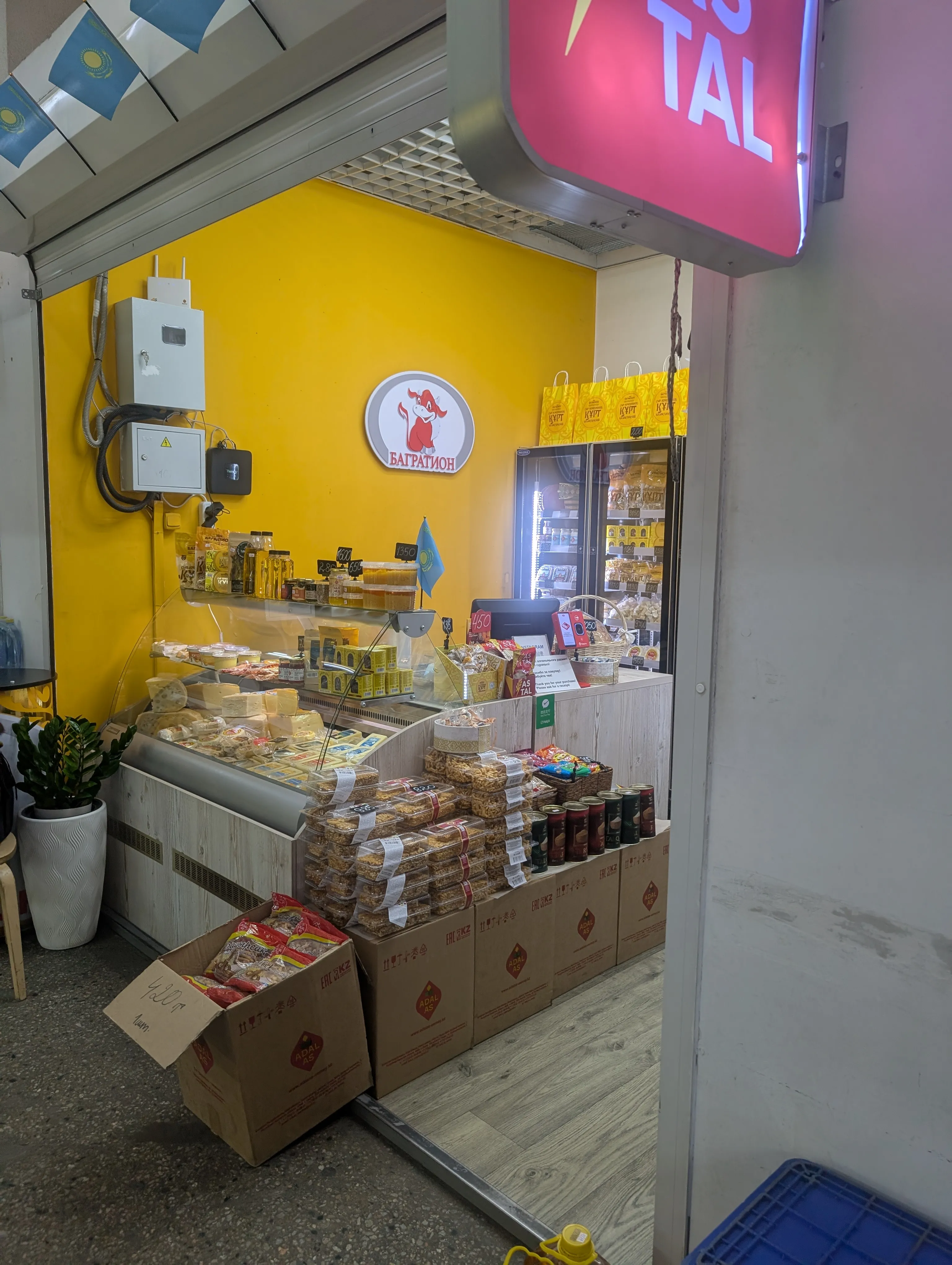
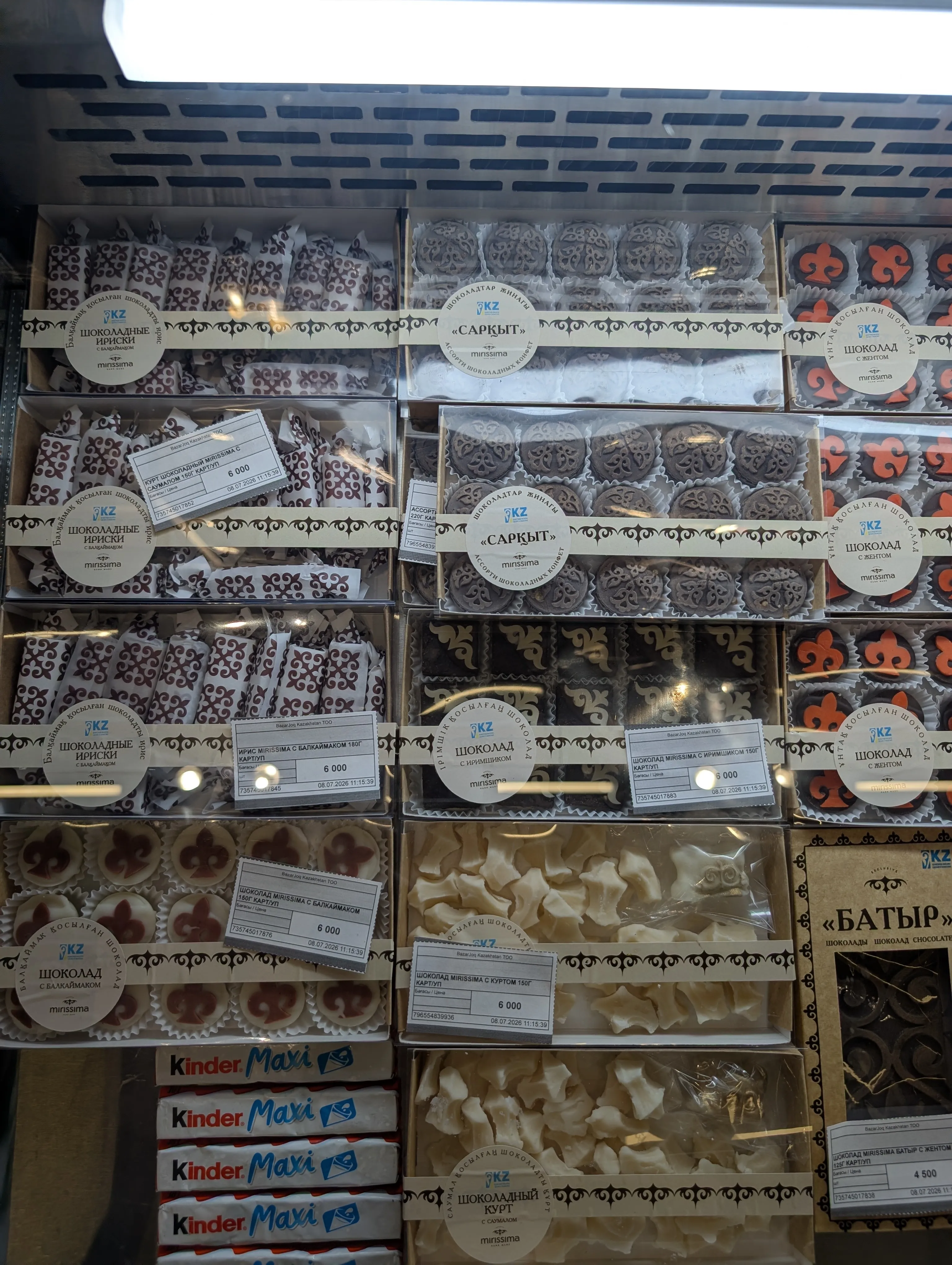
The Rahat shop, across Zenkov Street
Zenkov St 2a · Maps
Leave the market on the Zenkov side and the factory is in front of you: a long concrete plant with the Rahat oval on the roof, LOTTE in red beside it, and шоколад и сладости over the shop underneath. This is not a franchise counter. The sweets on those shelves are made in the building you are standing in front of, which is the reason to cross the street rather than buy the same bars off a stall.
It has been making them since 1942, when the Almaty Confectionery Factory was put together out of the city distillery's workshops and the equipment of two Moscow confectioners, Babayevsky and Rot Front — a wartime evacuation that never went home. It was renamed Rahat at the end of 1992. In July 2013 the Korean group LOTTE bought about three quarters of it for $156.6 million and the rest that December, and the company has been AO LOTTE Rahat since May 2021. That is what the two signs on the roof are: a Soviet-era Kazakh chocolate, Korean-owned since 2013, still made on the same block. Those dates and the sale figure come from the factory's Russian-language Wikipedia entry, read on 30 August 2026; there is no English page worth linking.
What things cost inside, read off the shelf tags on 30 August 2026. The shop prices in tenge to the last unit, so these are the tags and not my rounding.
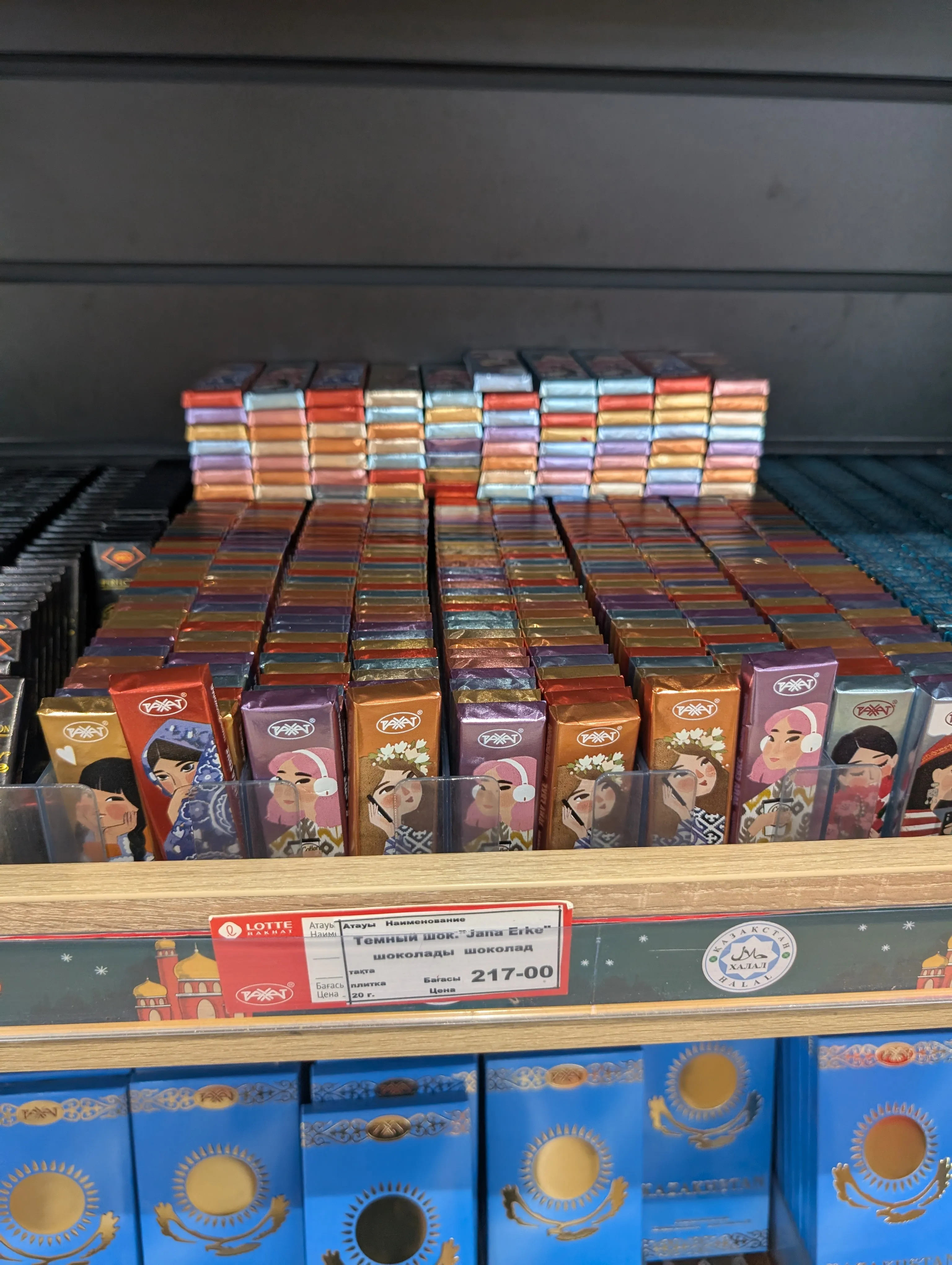
- A 20 g Jana Erke dark bar — 217 ₸ · ≈$0.50. This is the one to buy by the armful. Thirty of them costs less than one box of anything else on this page, they are wrapped in the sort of illustration people keep, and nobody at home has seen one.
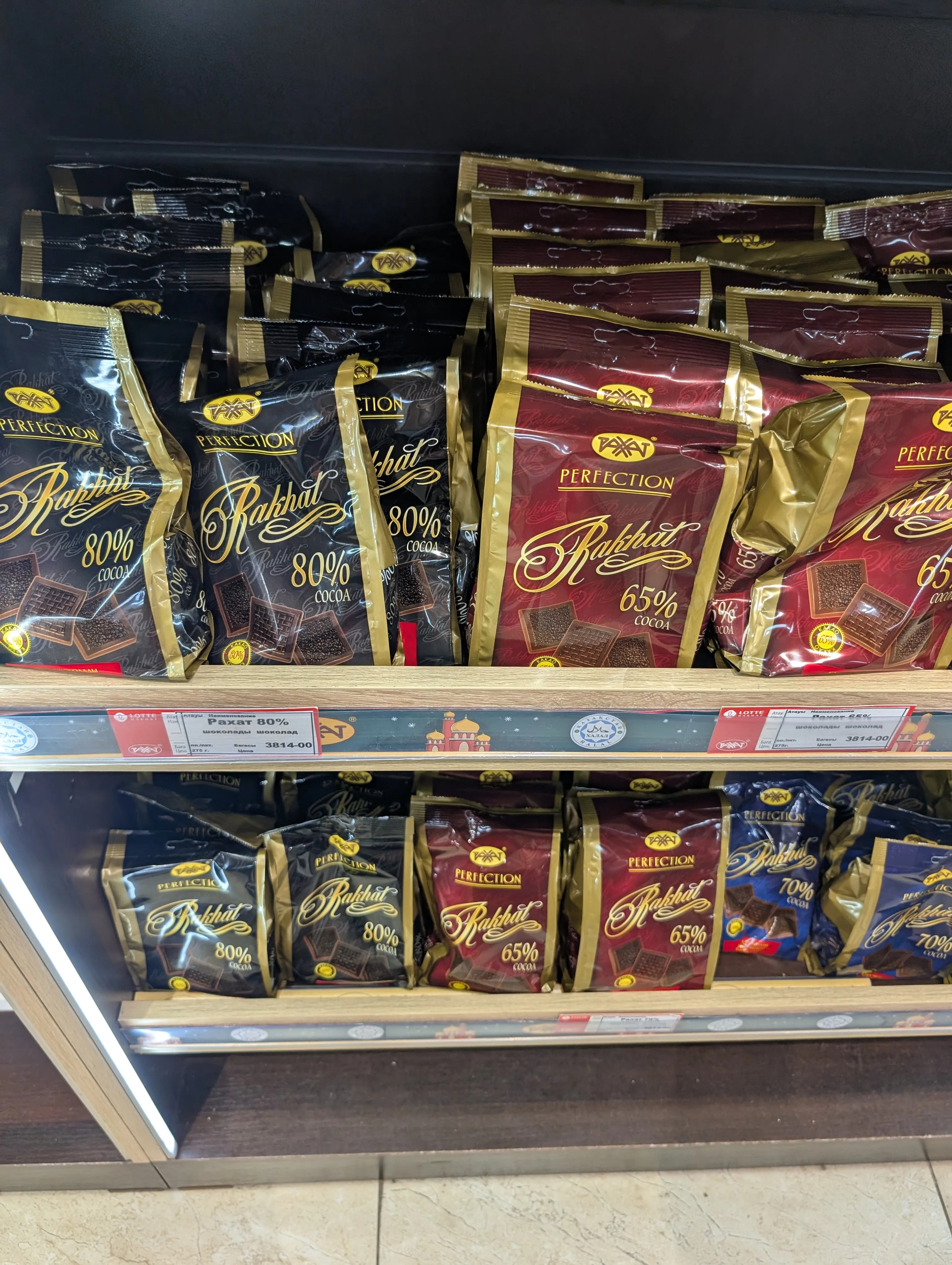
- Perfection 80%, a 275 g bag of squares — 3,814 ₸ · ≈$8. The bag rather than the bar, so it survives being shared. The same shelf runs 65% and 70% at the same price.
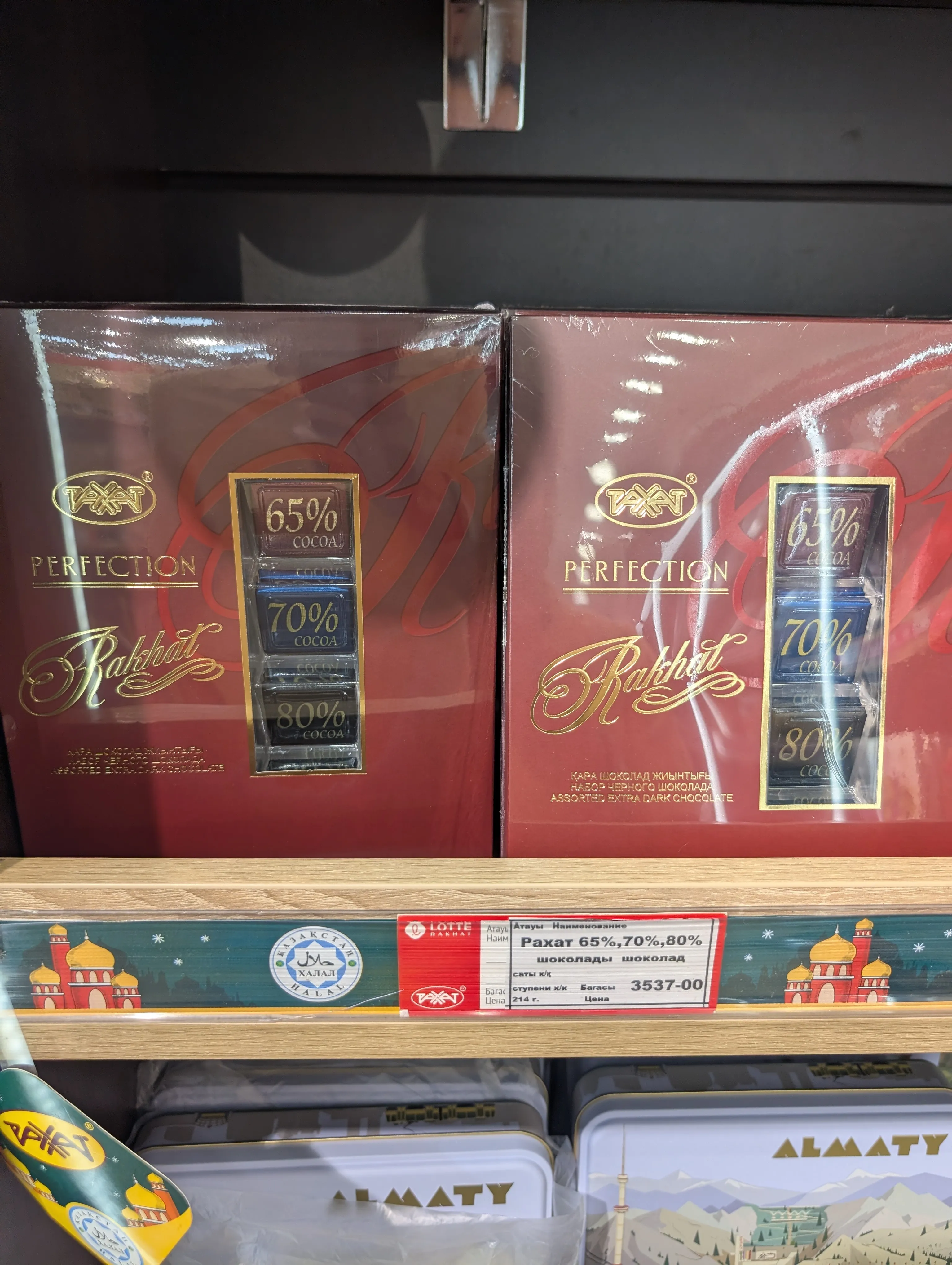
- The Perfection assorted box, 65/70/80% in 214 g — 3,537 ₸ · ≈$7.50. A gift that looks like a gift, and the one I would hand to someone who takes chocolate seriously: three strengths of the same house style, side by side.
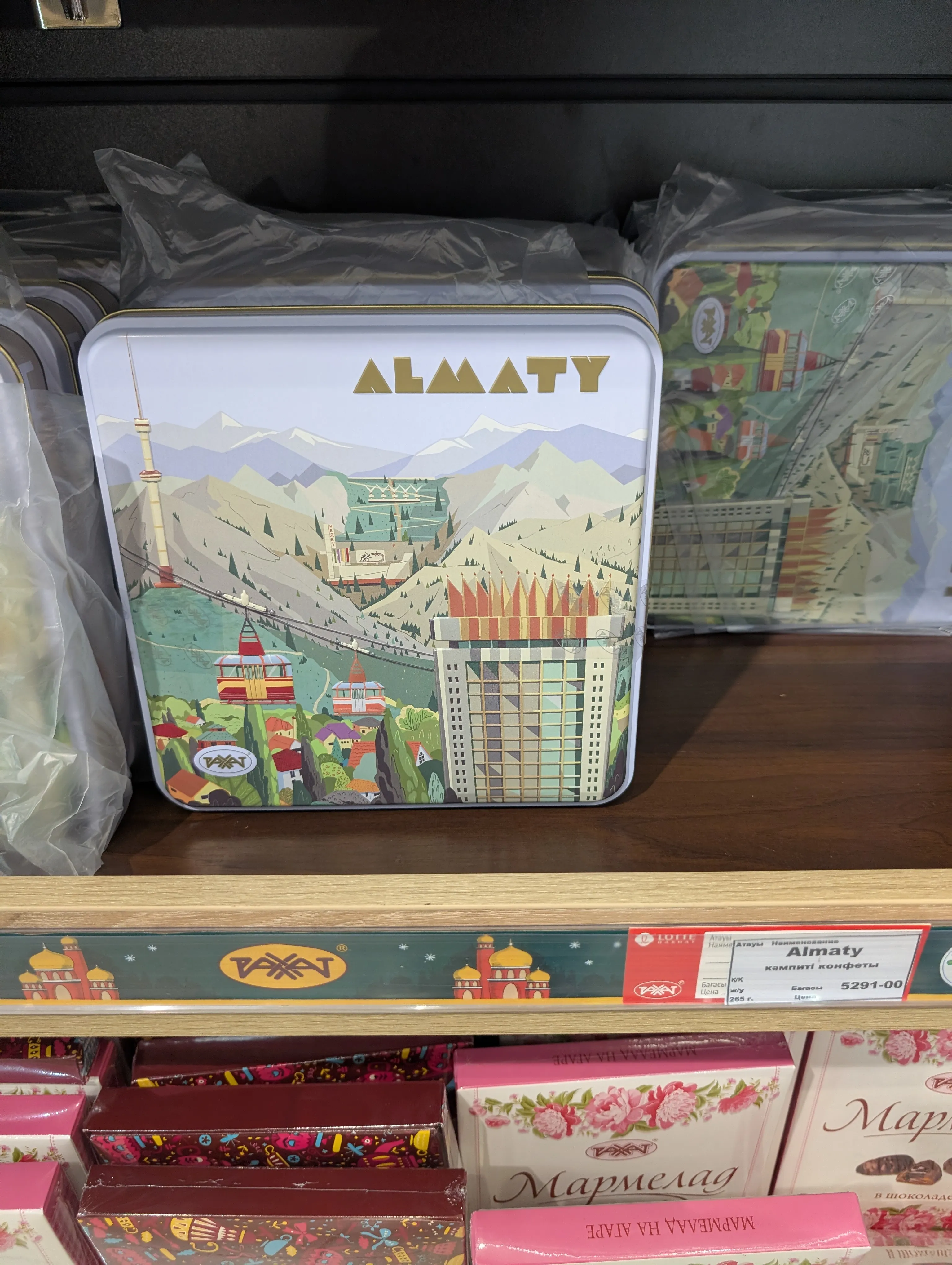
- The Almaty tin, 265 g of sweets — 5,291 ₸ · ≈$11.50. You are paying for the tin, and the tin is worth it — the lid is a travel poster of the city with the cable car, the tower on the ridge, the mountains behind and Hotel Kazakhstan's crown in the middle of it. The sweets are gone in a week and the tin stays on a shelf.
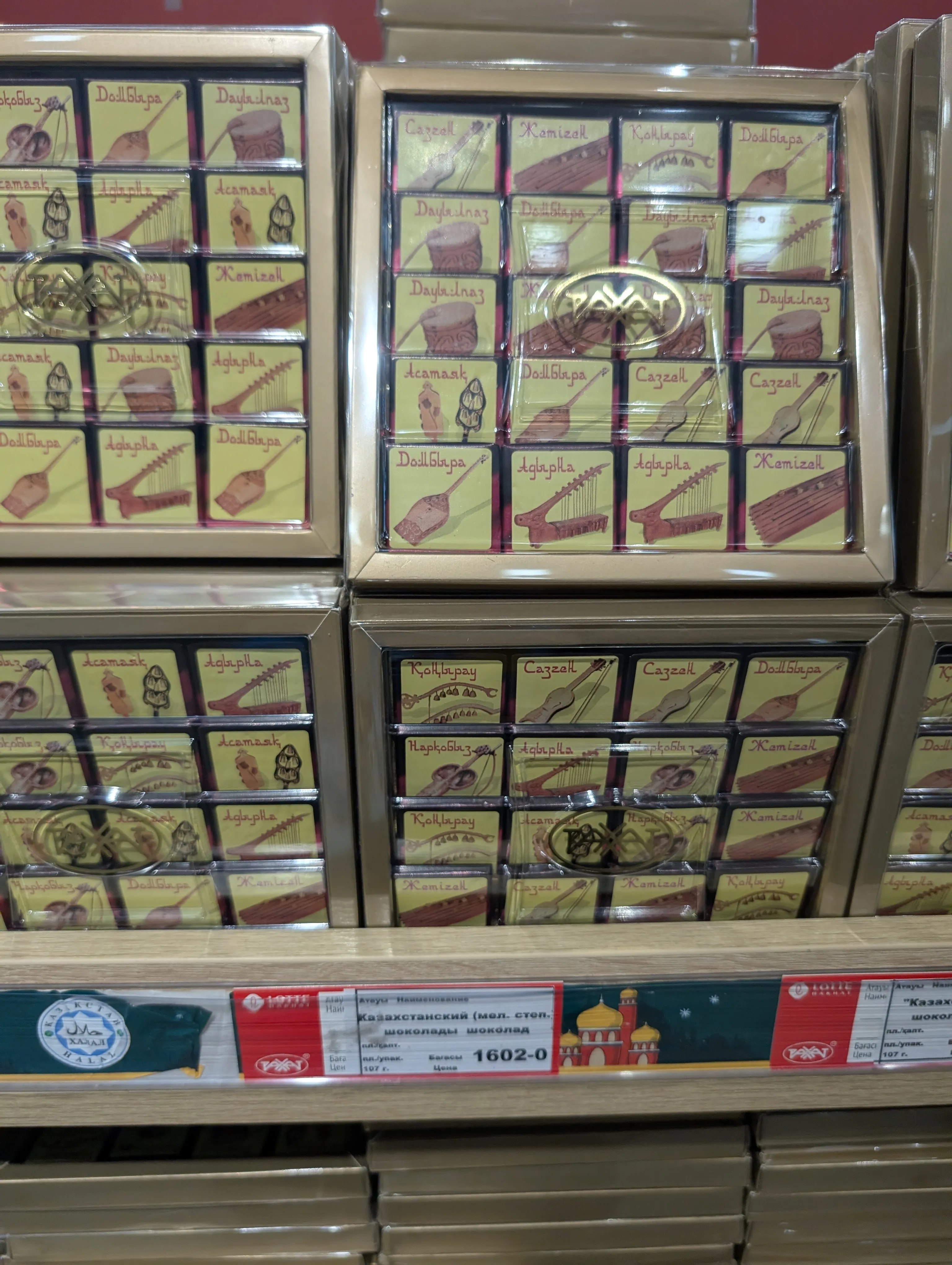
- Boxed bars printed with Kazakh instruments — 1,602 ₸ · ≈$3.50. Dombyra, kobyz, zhetigen, sazsyrnai, one to a square, under a tag reading Казахстанский. Note the mismatch with the bar of the same name at the bazaar, which I have at 1,000 ₸ — different format or a different day. Read the tag rather than trusting either number.
Kampit, at PlatformA
Abylai Khan Ave 125 · from 10am · Maps
Caramelised almonds, hazelnuts and cashews in Belgian chocolate, sold by the box. A small box is 4,250 ₸ · ≈$9 and a large one 10,000 ₸ · ≈$21.50 — four to ten times the Rahat bar, which tells you what this is. A local luxury rather than a pocket souvenir: buy it for one person you actually like, not for the office.
The counter is inside PlatformA, a food market two minutes up Abylai Khan from Bal, which is at number 104 on the same avenue. Worth pairing if you are going to either.
Wine, which nobody expects
Arba Wine · Abylai Khan Ave 71 · midday to 10pm · Maps
Kazakhstan makes wine, which almost nobody arrives knowing. Arba grows theirs in the Assa Valley outside the city, and the Pinot Noir and the Riesling are both properly good — not good-for-Kazakhstan, good. That is the one claim on this page I would defend in an argument.
Their Almaty boutique is at Abylai Khan 71. Which makes three stops on this page on one avenue: Arba at 71, Bal at 104, PlatformA at 125. If you are walking any of it, walk the rest.
Chocolate with qurt, at Petit
Petit sells chocolate with qurt in it. Salted dried cheese inside a chocolate bar is not a combination you will meet anywhere else, and the shop is small enough that it is worth asking what else they have made that week.
Something that is not edible
Argymaq · Kabanbai Batyr St 104 · Maps
Clothing, jewellery and souvenirs in Kazakh national style. It is at Kabanbai Batyr 104 — the same building as Fika, so it pairs with breakfast rather than needing a trip of its own. The building is the Turksib House of 1953 and is worth a look up on the way in; it is on the architecture walk.
Then walk the street rather than ordering a car off it. Kabanbai Batyr is one of the most walkable streets in Almaty and one of the best loved by people who live here — mine included. If you only have an hour spare and no plan for it, spend the hour here.
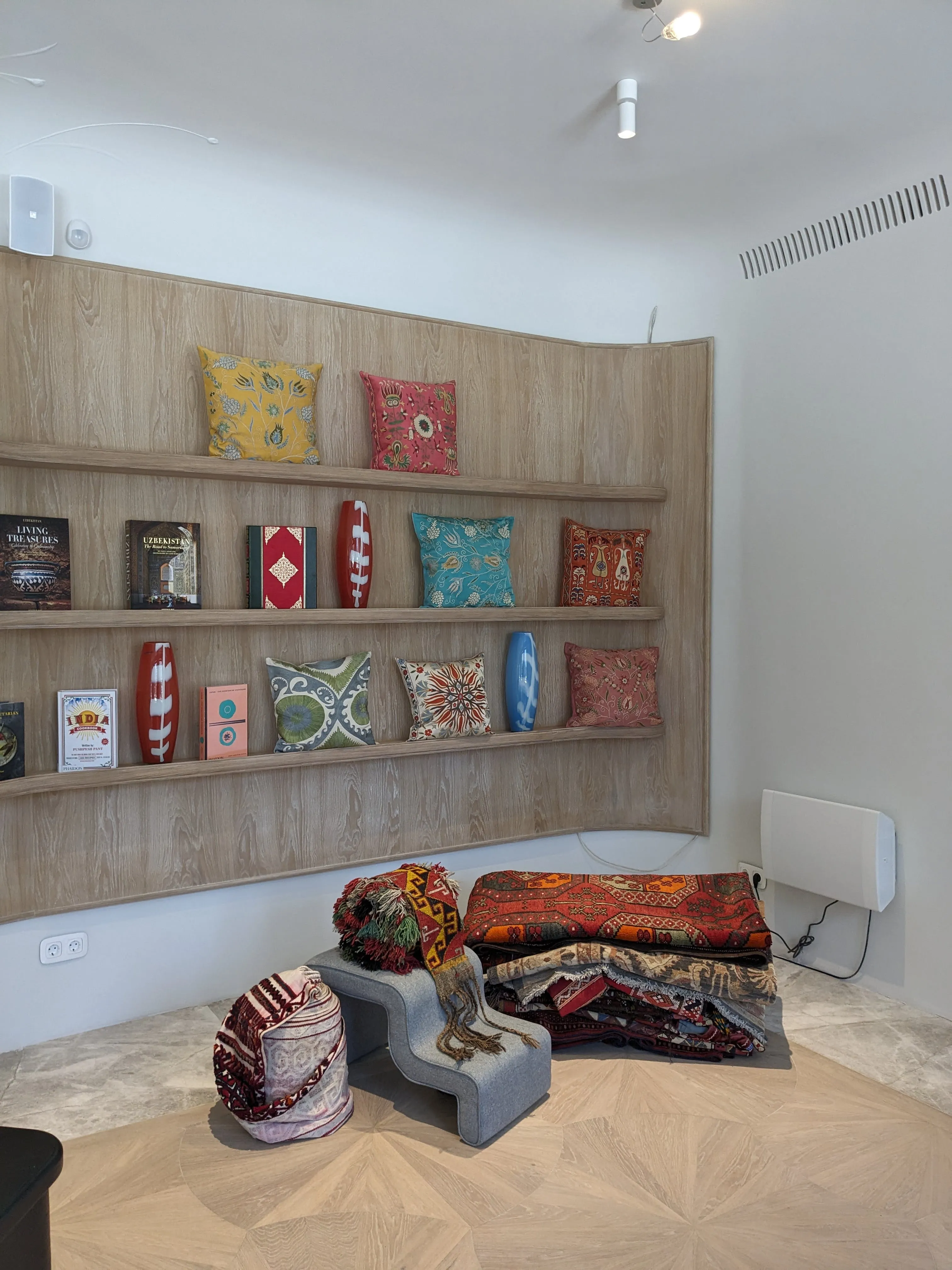
Korkem is a shop of the same sort — a room of embroidered cushions, felt and folded textiles, with the odd small sculpture on a shelf — and a cafe in the same room, which is the part nobody expects. I drink there; I have not priced the textiles or noted the hours, so treat the shopping half as a photograph and a name to search rather than a checked entry like the rest of this page.
If you would rather have one good object
Dunie · dunie.studio
Everything else on this page is a shop or a stall. This is a design studio, and it is the answer if you want to take back one thing rather than a bag of things. Dunie in Turkic means the world — both the material one and the whole universe — and what they make are ordinary Kazakh objects redrawn: a kese, the bowl tea is drunk from here; a körpe, the quilted mat you sit on; tabaq plates, felt alakiiz, woven terme.
The kese is the one to start with, at $80. It is the object you will actually use — every household here has a shelf of them — and it costs less than the carpets and the quilts do. Plates run to $105, a mini körpe $85, a full one $215, and their felt pieces go to $760 and sell out. Prices from their own catalogue on 28 August 2026, and they are listed in dollars, which tells you who the studio thinks it is selling to.
I have not bought from them, so treat this as a pointer rather than a verdict — but the reason it is here is what they say they are doing: working with local manufacturers and artisans on techniques from this region rather than printing an ornament onto something imported. That is a rarer thing than the souvenir shelves suggest.
Beans
Nine of the places on the coffee list roast their own, and the ones that do generally sell bags over the counter — ask. Beans travel well, clear customs anywhere, and are the one souvenir here that a coffee drinker will actually finish.
If you only want one bag, buy it where you liked the espresso. The score on each card is for what came out of their machine, which is a better guide to their roasting than anything written on the packaging.
One warning, and it matters
Qurt is a dairy product, and you cannot take it into the European Union. The rule is blunt: travellers arriving from outside the EU are not allowed to bring any meat or dairy products in their luggage. Undeclared food is confiscated and destroyed, and you can be fined on top.
The United States is the opposite. The USDA exempts solid hard or soft cheeses from every country, including ones it otherwise restricts — and qurt is about as solid and hard as cheese gets. Declare it anyway. The inspector makes the final call, and the USDA is explicit that a traveller who declares everything faces no penalty even when an item is refused. Stay quiet and you lose that protection.
Wine has its own limits, and they are tighter than people assume. The EU allows four litres of still wine duty-free from outside the union — five bottles, near enough. The United States allows one litre duty-free to travellers over 21, which is barely more than a single bottle; beyond that you pay duty, and the rules of the state you land in apply as well.
Flying anywhere else, check before you fill a bag. Jent, chocolate and coffee travel without any of this.
Last updated .