The school in these mountains
Most visitors read the range above Almaty as scenery. It is also a school, and it has been one since the 1930s — with an alpine camp forty minutes from the city where you can still enrol, sleep, eat and be taught to climb by people who do it for a living.
This is the part of the city that is genuinely world class and almost never mentioned to the people who visit it. If you have read one book about Everest, you have already met one of these mountains' climbers without knowing where he came from.
Why here
Look at the camp's own table of routes and the argument makes itself. The first ascents in the Tuyuksu cirque are dated 1930, and the list never stops: the thirties, the war years, the fifties, and then a run of new lines through the nineties and two-thousands put up by Denis Urubko, who went on to become one of the strongest high-altitude climbers alive. There are peaks here named after climbers who died on other mountains.
That is the distinction worth holding on to. This is not a heritage story about a glorious past — it is a working school with an unbroken paper trail, and the ninety-year-old routes and the ones opened in 2018 are in the same table.
Anatoli Boukreev
If the name is familiar, it is probably from Into Thin Air. Boukreev was the Kazakhstan-based climber on Everest in 1996 who, when the storm came in and people were dying above the South Col, went back out into it alone, at night, and carried climbers down. Jon Krakauer's book was hard on him. The American Alpine Club gave him its David Sowles award — the one for risking yourself to rescue somebody else — and he wrote his own account, The Climb, in reply.
He climbed most of the world's eight-thousanders without supplemental oxygen. He died in an avalanche on Annapurna on 25 December 1997.
There is a sculpture of him in front of the skating rink at Medeu, unveiled in January 2023, showing him resting before a climb. It sits exactly where everybody's first walk above this city starts — you will pass it on the way to the steps if you do the Medeu to Gorelnik walk. Most people who photograph the rink never look at it.
The rink behind it closed for reconstruction in 2025 and is not due back until late 2027. Going up on foot is unaffected — the steps are open and you can still walk to him.
One thing to keep straight if you go looking for the peak named after him: Pik Boukreev is 3,010 m and is reached from Butakovka, an ordinary long day out of the city. It was called Pionersky until climbers renamed it in 2007. It is not the Pioneer that appears on the camp's route list at 4,031 m — that is a different mountain in the Tuyuksu cirque, still under its old name. The two are easy to confuse and a long way apart in difficulty.
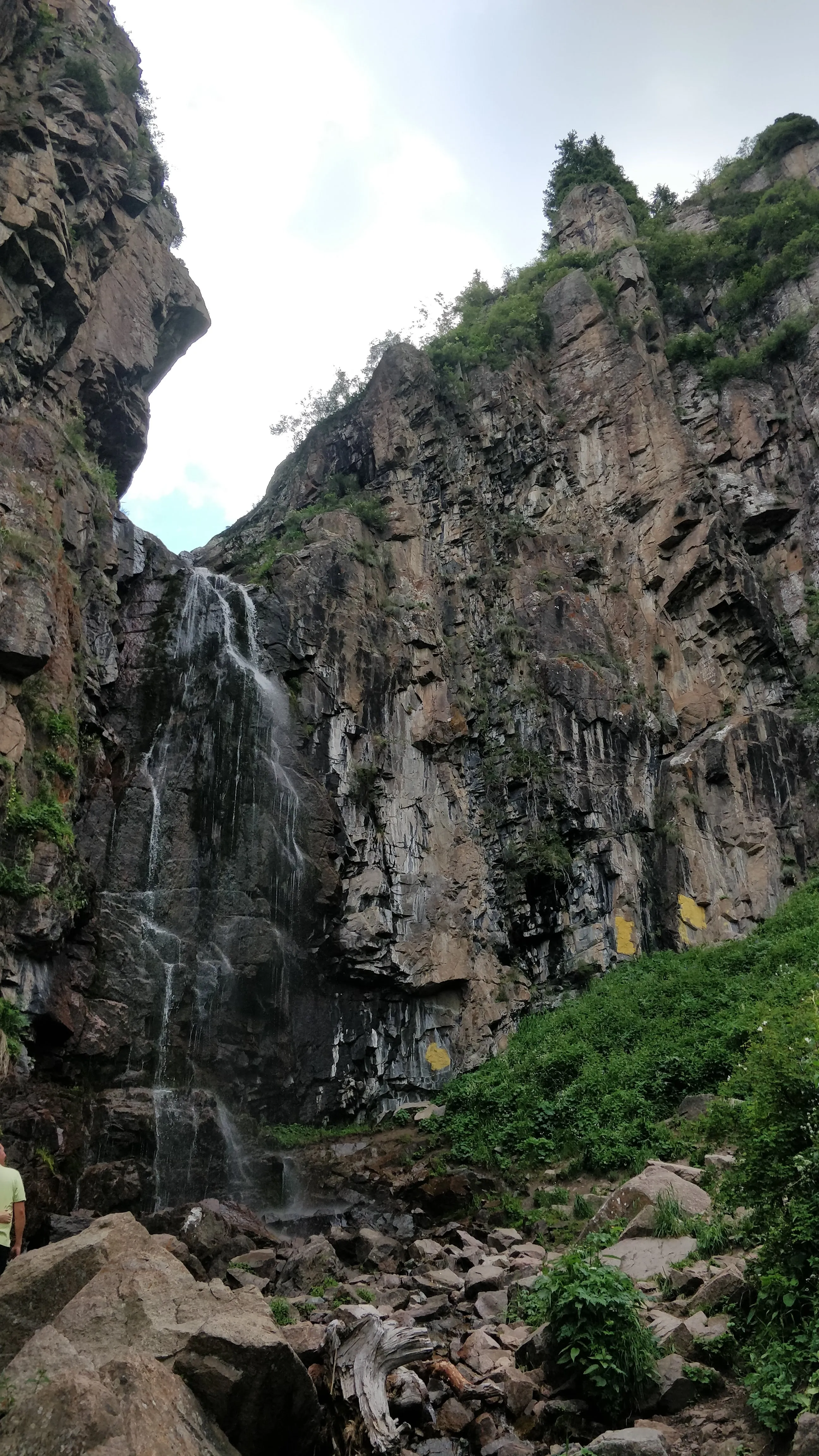
That is Butakovka — the waterfall rather than the peak, and a gentler walk than either. It is the valley you start from, and a good enough day out on its own if the summit is more than you came for.
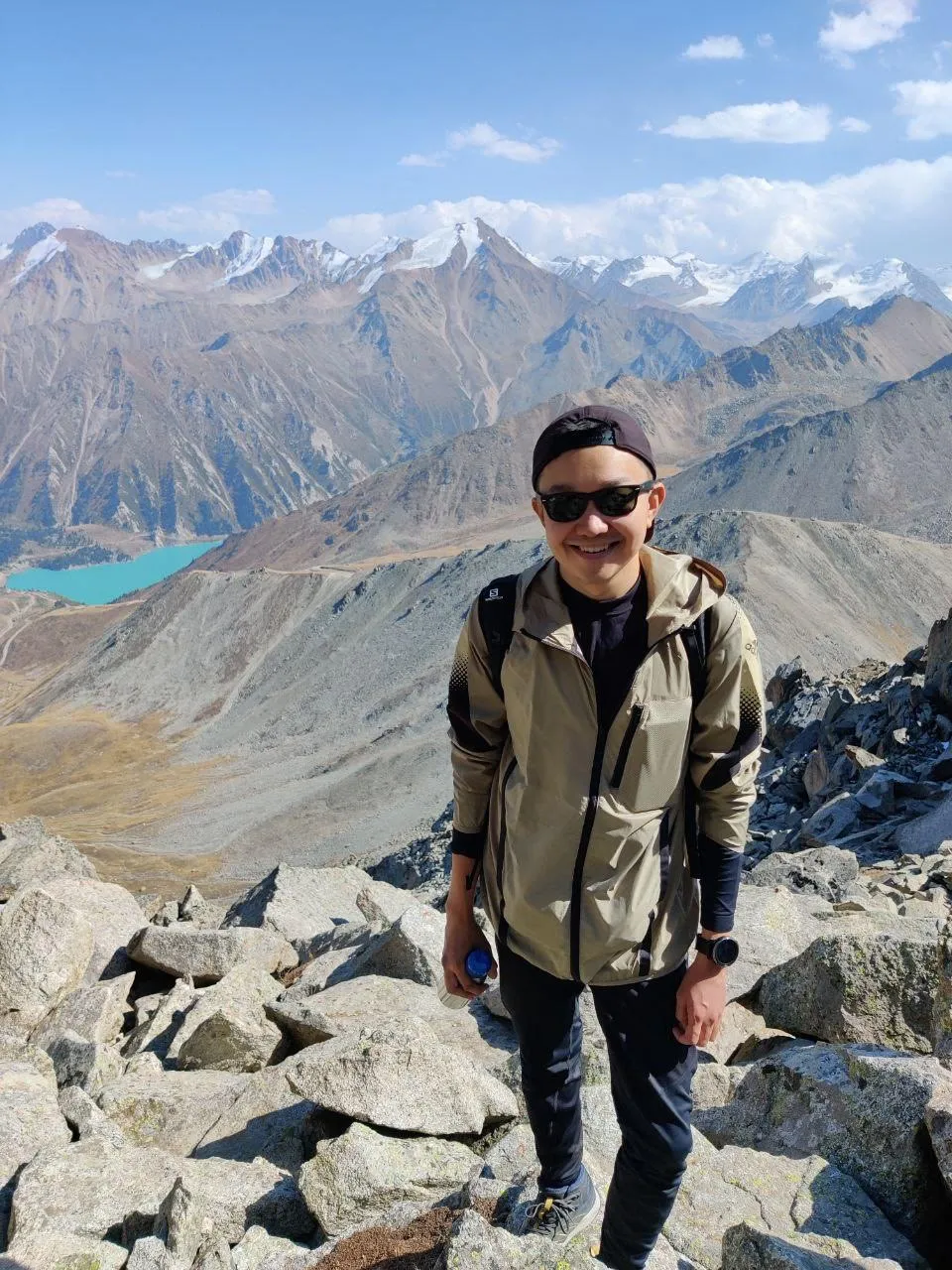
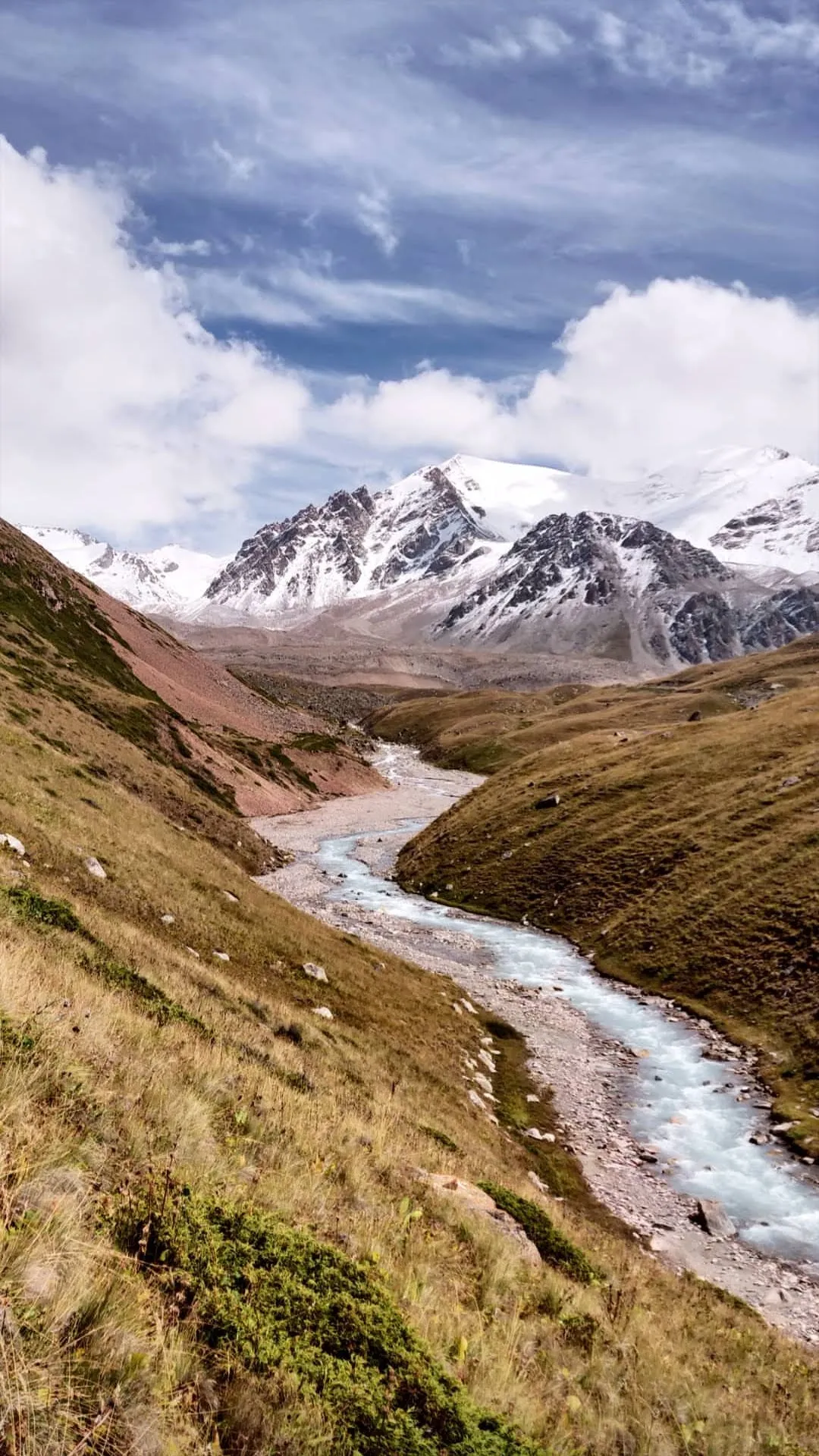
Both of those are day walks with a hired guide, not a shift at the camp — which, as the camp itself says below, is the right way to be up here if a course is not what you came for.
The camp at Tuyuksu
The alpine camp sits in the tree line about forty minutes from Almaty by car, three hours if you walk in, with summits of 3,650 to 4,410 m around it. It runs almost all year — winter and summer constantly, spring and autumn less often, and nothing in April or October.
Be clear about what it is, because they are. In their own words: teaching comes first and summits second, and if you would rather just walk in the mountains without any of that, what you want is a guide, not a course. They will help you find one. If a walk is what you are after, start with the four routes out of the city instead.
Courses — shifts — run two weeks. The ladder is fixed and you cannot skip a rung: the Alpinist of Kazakhstan badge first, then third grade, second, part of first, and finally clearance to climb unsupervised. Beginners typically get three summits in a shift, graded climbers five, weather permitting. The badge is recognised across the former Soviet countries.
What it costs
Their 2026 prices, in tenge, for an ordinary shift — the New Year and student shifts are priced differently:
| Programme | Length | Price |
|---|---|---|
| Beginners week — rock, ice, one 4,000 m summit | 1 week | 215,000 ₸ |
| Novice through to third grade | 2 weeks | 365,000 ₸ |
| Second grade to first | 2 weeks | 395,000 ₸ |
| Independent climbing, camp support only | 2 weeks | 330,000 ₸ |
| Clearance only — no lodging, food or instructor | 2 weeks | 42,000 ₸ |
| Instructor school | 3 weeks | 580,000 ₸ |
Lodging, food and the instructor are inside that price. Read on their schedule page on 27 August 2026; the programmes describe what each one teaches. These are their numbers, not ones I have handed over.
You book with a 20% deposit online and settle the rest online or in the camp, by card or cash. Cancel more than a month ahead and the deposit comes back; later than that, it does not. They will collect you from the airport or the station.
Medical insurance is not optional. It has to name mountaineering specifically, or the insurer will refuse the claim and the camp will refuse to let you climb. Sort this before you fly rather than the week you arrive.
What it is like to stay there
I have stayed at the camp twice. I slept in tents both times; there are barracks as well, and bedding, pillows and the rest are provided, so a sleeping bag is only for nights you already know you are spending outside the camp.
There is a shower — two visits free, then 2,000 ₸ — and a banya at 15,000 ₸ an hour for up to six people. Electricity is constant. Mobile signal works in the camp on Janymda, the old Beeline, and on Kcell or Activ, though not reliably higher up. Meals come with the shift: breakfast, lunch or something to carry up the mountain, and dinner.
In winter it goes to −30 °C. That is not a detail to discover on arrival, and it is worth starting to train two or three months before you come — their advice, and it is sound. The difference is whether the climbing feels like a holiday or like survival.
If you do not have two weeks
Hire one of their guides for a day. I did exactly that for the walk up to Manshuk Mametova lake, and it is the cheapest way to find out whether the two-week version is for you — high mountains, a real guide, and home the same evening.
This is also the honest scale of the thing. A two-week shift is a holiday's worth of time, which makes it a plan for somebody living here rather than passing through. If you are here for a fortnight, take the day walk. If you have moved here, the course is one of the best things this city can give you, and it is the one I want to do myself.
The language
Plan on Russian. The camp has no English version of its site — the address exists but returns a not-found page — and the whole FAQ is written for a Russian-speaking audience, down to visa rules for Russian citizens and how grades are recognised by Russian federations.
What I am not going to tell you is that nobody there speaks English. I do not know that, and a website is not proof of it. Email them and ask before you pay a deposit — they answer within a day, and it is a fair question that costs you nothing to put.
Common questions
Can a beginner learn mountaineering in Almaty?
Yes. The alpine camp at Tuyuksu, forty minutes from the city, runs two-week courses that take people with no experience at all and teach them to climb, starting with the "Alpinist of Kazakhstan" badge. Their own order of priorities is teaching first, summits second.
How much does a mountaineering course in Almaty cost?
For 2026 the camp lists 215,000 ₸ for a one-week beginners programme and 365,000 ₸ for the two-week course that takes a novice through to the third grade. Accommodation, food and the instructor are included in that.
Is the alpine camp in English?
Assume not. The camp has no English version of its website and its whole FAQ is written for a Russian-speaking audience. Whether an individual instructor speaks English is a question to put to them by email before you pay a deposit.
Who was Anatoli Boukreev?
A Kazakhstan-based mountaineer who climbed most of the world’s 8,000-metre peaks without supplemental oxygen, and who is best known abroad for the 1996 Everest disaster, where he went out alone into the storm and brought climbers back alive. He died in an avalanche on Annapurna in December 1997. There is a sculpture of him in front of the skating rink at Medeu.
Where is the Boukreev monument in Almaty?
In front of the Medeu skating rink, unveiled in January 2023. It stands at the point where most walks above the city begin, so you pass it on the way to the steps and Gorelnik.
Last updated .