Before you go
Sort these out before you land and the first day gets much easier. I live here; this is what I tell friends who are flying in.
Mobile data: buy an eSIM before you fly
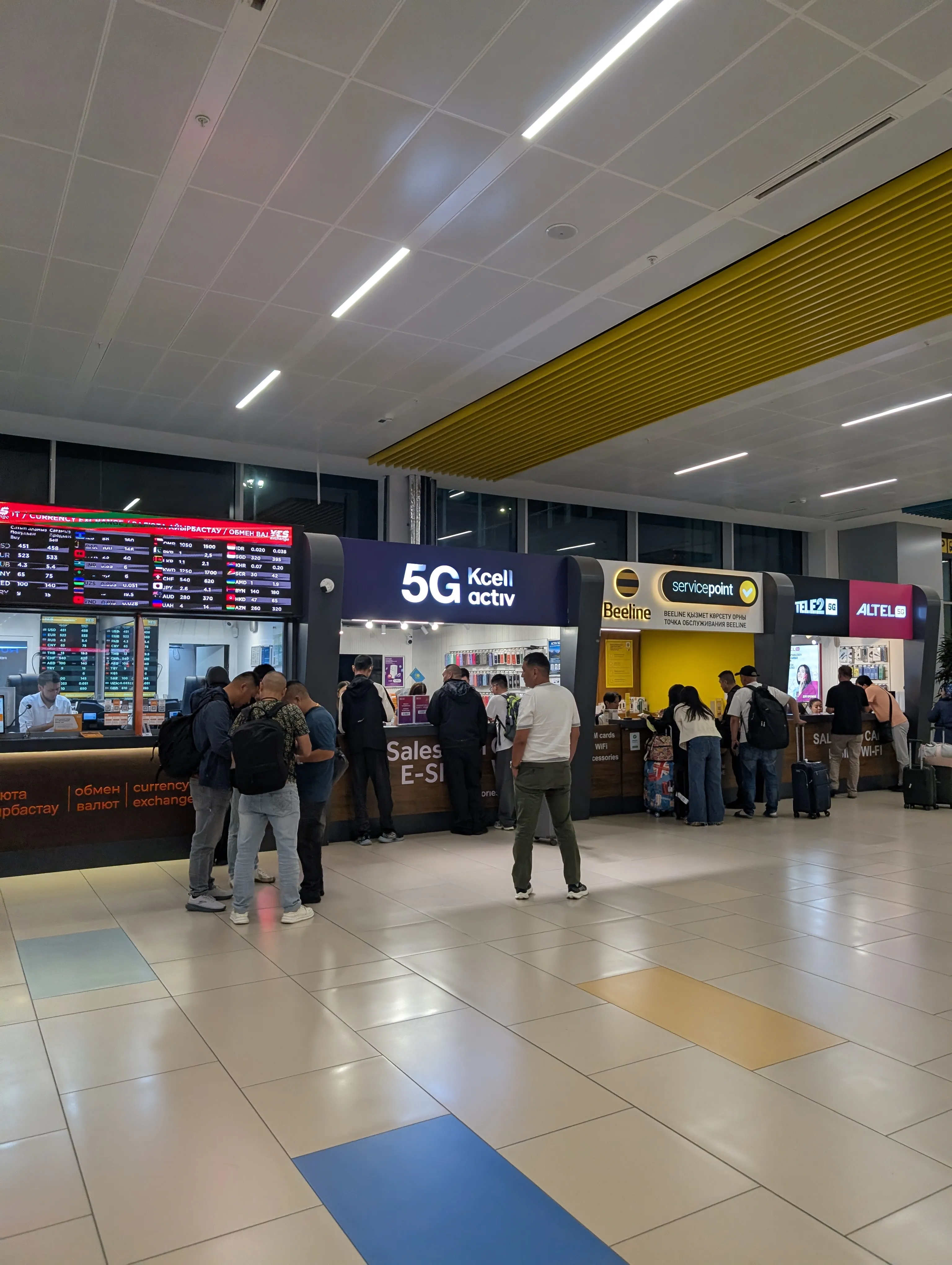
This is the one thing genuinely worth doing in advance, and the reason is not convenience. A local SIM card takes one to two business days to activate. On a week-long trip that is a quarter of your visit spent offline.
It gets worse. Since March 2025 Kazakhstan requires foreign visitors using a local SIM to register their phone's IMEI, and the SIM binds to that one handset — move it to another phone and it stops working after 30 days. An eSIM sidesteps all of it: eSIM users are not subject to the IMEI registration requirement at all.
Get 3–5 GB from any eSIM provider before you board. Airalo starts around $4 for 1 GB over 3 days and about $11 for 5 GB over 7 days, running on Kcell and Tele2. It is data-only — no local number — but WhatsApp, Telegram and iMessage all work over data, which is how everyone here communicates anyway.
Enter the code SANZHA9288 when you sign up and you get $3 off your first eSIM. I get $3 too — that is the only thing on this site I earn anything from, it costs you nothing, and it has no bearing on any coffee I recommend.
Public wifi is genuinely everywhere in the city — cafes, malls, the metro — so 3–5 GB goes a long way. You mainly need your own data for the taxi app and maps while moving around.
Getting in from the airport
Install Yandex Go before you fly and add your card to it. It is the taxi app everyone here uses, it works in English, and having it ready means you are not setting up an account while jetlagged in an arrivals hall.
At the airport, do not go with the men offering you a ride. Walk past them and order through the app like you would at home. The touts charge several times the real fare and the app shows you the price before you accept.
The airport run into the city is roughly $10–15 in the app. Expect more at surge times — late arrivals and bad weather push it up. If someone in the terminal quotes you well above that, you have found a tout.
The two apps to install
Yandex Go for taxis, as above.
2GIS is the local one nobody tells you about, and it is better than Google Maps here. Opening hours, whether a place has actually closed down, road works and road conditions — 2GIS is more current on all of it, because it is what locals use and correct. If a cafe on my guide shows different hours on Google, trust 2GIS.
Money and paying for things
Card payment is normal here — Visa, Mastercard and UnionPay all work in cafes, shops and on the metro. You do not need to arrive with a pocket full of tenge.
You will also see Kaspi QR everywhere — you scan a code to pay. It accepts any bank card, so it is not the locals-only trap it looks like.
Do carry a little cash anyway for the smallest places and the bazaars.
Getting around
The metro is one line, clean, and costs 120 ₸ a ride(roughly $0.25). You can pay with a bank card at the turnstile — Visa, Mastercard or UnionPay — so there is no need to buy a transport card for a short trip. A single-use smart token is also 120 ₸; a reusable smart card costs 180 ₸ on top of the fares.
For everything the metro does not reach, Yandex Go is cheap by European or American standards.
Yandex Go also has an intercity tariff, which is worth knowing about and worth knowing the limits of. It runs on fixed routes with the price shown before you book, either as a whole car or shared with up to three other passengers. From Almaty it currently serves six destinations: Konayev from 2,500 ₸, Kordai and Taldykorgan from 5,000 ₸, Ushtobe from 6,000 ₸, and Zharkent and Shu from 6,500 ₸.
What it does not do is the thing most visitors want it for. There is no intercity route to Charyn Canyon, or to Kolsai, Kaindy or Saty. The Zharkent route runs along the same highway and passes the canyon turnoff, but you cannot be dropped there — it is a fixed city-to-city route, and the visitor centre sits off the road. For the canyons you need a tour, a hired driver for the day, or your own car.
Renting a car
Kazakhstan signed up to the 1968 Vienna Convention on Road Traffic in 1994, which is the framework that makes a foreign licence usable here. In practice it comes down to one question: is your licence printed in the Latin alphabet? Rental desks in Almaty ask for a passport and either an international driving permit or a national licence with your name in Latin script. Most British, EU and American licences already qualify.
Even so, bring the permit. The UK government tells British drivers they need a 1968-format IDP alongside their UK licence, and rental companies routinely set stricter conditions than the law does. An IDP costs very little, ends any argument at the desk or at a roadside check, and cannot be bought once you have arrived — it has to be issued in the country that gave you your licence, before you fly.
Carry the licence itself as well. An IDP is a translation and nothing more, so it is only valid next to the document it translates — counters ask for both originals, and photocopies or photos on your phone are not accepted.
Check the age limit on the specific rental before you book.It is the requirement most likely to catch you out, and it is not one number: local firms tend to start around 21, while the international chains set the bar higher — Avis, which has a downtown office and a 24-hour desk at the airport, starts at 25 on its own booking form. Several also want the licence to have been held for a couple of years. Expect a minimum rental of 24 hours and a deposit on a credit card in the main driver's name.
One thing to weigh before you book: a car is a burden inside Almaty, where Yandex Go is cheap and parking is not, and a genuine unlock outside it, where the mountains and the canyons have no other practical transport. Rent for the days you are leaving the city, not for the whole trip.
Which car matters as much as which company. Outside winter a normal saloon will get you as far as Kolsai, where there are cabins if you want to stay the night. It will not get you to Assy Plateau or to Kaindy — both of those need a 4x4. Kaindy lies a little beyond Kolsai, which is the trap: the same day that reaches the first lake in comfort can stop dead before the second one. If Assy is on your list, book the 4x4 from the start rather than discovering the problem at the turnoff; for Kaindy the cheaper answer is to sleep at Kolsai and let the guesthouse drive you the last stretch.
Check the mileage limit before you check the daily rate. It applies to the whole rental rather than to each day, and the drive to the lakes is 584 km before you turn off anywhere. The renting a car page has the numbers, the companies and the paperwork in full.
What to wear
From autumn onwards the rule is layers, and the reason is the one thing worth knowing about weather here: it changes through the day. A warm morning turns cold and wet by afternoon and back again.
So go out with a backpack and a windbreaker or rain shell inside it. That is genuinely the whole trick — locals do exactly this, and it is why nobody here dresses for the forecast.
Summer needs no strategy. It is simply hot.
If you have hay fever
Worth knowing, because no guide to this city mentions it: Almaty has high pollen activity, and it is seasonal. If you react to pollen anywhere else, you will react here, and a bad week can quietly ruin a short trip.
Check the Yandex Weather pollen map for Almaty before you book, and again before you fly. It shows current levels and what is flowering. Bring your usual antihistamine rather than planning to find it here.
Language
Finding English speakers is not a problem, especially among younger people and in any specialty coffee shop — the baristas on my coffee list will all understand your order. Russian and Kazakh are what you will hear around you.
For signs and menus, Yandex Translate is the one to have rather than Google — its camera mode reads Cyrillic cleanly, where Google's still mangles it. Download the Russian language pack before you fly and both the camera and the text box keep working with no connection. It handles Kazakh too.
Worth a minute before you land: a dozen Kazakh phrases written the way an English speaker should say them. None of them will get anything done — that is deliberate — but a greeting and a thank-you in Kazakh land differently here than the same words in Russian.
Listen to some music before you fly
Kazakh culture was a sung one long before it was a written one. The akyn is a poet who composes out loud to a dombyra, and aitys — two of them improvising verse at each other until one runs out — is still broadcast on television here and still argued about afterwards. That is the background to something you will notice on your first day: music is not wallpaper in this city. It is on in the taxi, in the barbershop and in the cafe, and everyone has an opinion about it.
So put an hour of it on before you fly. Knowing one artist by name will get you further in a conversation here than any phrase you memorise, and you will recognise some of what is playing around you instead of tuning it out.
The best single window into it is OYU, a live-session project that films musicians from across Central Asia and puts out a new one most weeks — Kazakh-language pop, indie, rap and R&B alongside singers your driver's parents grew up on, all performed live and shot properly. Start at the top of the channel and let it run. It has since grown into a festival, which tells you how much of the current scene passes through it.
Where to stay
Booking and Airbnb both have real inventory here, so book through whichever you already use. Staying anywhere in the centre puts most of the coffee on my list within walking distance.
For a night outside the city — a yurt or a cabin in the mountains an hour out — see nights out of town. That list is deliberately short, because it only holds places somebody I trust has slept in.
Questions people actually ask me
- Is Kazakhstan safe?
- Yes. It is a safe country where you will not be kidnapped by the mafia or attacked by terrorists. I would not leave a phone or a purse unattended on a table, though — the same as anywhere.
- Is it safe to walk around at night?
- Yes.
- Should I tip servers?
- A 10% service fee is already added to your restaurant bill. Tipping on top is a nice gesture, but I will not think less of you if you skip it.
- I am a woman. Can I wear tank tops and shorts?
- Yes, though you will attract some looks. It depends where you go.
- Is it acceptable to photograph people?
- Yes.
- Is there anything I should avoid doing so I do not seem disrespectful?
- Do not mention Borat. And if you are a man greeting a man older than you, offering both hands reads as a mark of respect.
- What type of electrical plugs are used?
- The same as in Europe.
- Can I find cigarettes and IQOS or GLO sticks easily?
- Yes. Almost every grocery shop sells them, and the prices are low enough that people take some home with them.
The rest of the planning
Where I would stay. Six hotels, picked for the door you step out of rather than the rooms — the Golden Square on foot, the road that runs straight to Shymbulak, the one with the gold crown, and the chains that hold no surprises.
See where to stay
What to take home. The souvenirs worth carrying back are edible, cheap and nearly all in one covered market — and one of them will be taken off you at the airport if you are flying to Europe.
See what to buy
When to come. Ski in the morning and watch ballet the same evening; a canyon by day and coffee under city lights by night. Which month suits you depends on which of those you came for.
See when to come
Last updated .