Museums, and the month that changed them
In September 2025 this city gained two major institutions of contemporary art in the space of a few weeks. If your guidebook was written before that autumn, its art section is simply out of date — so start with what is new, and then go back for the older ones, which were never the weak part.
What follows is the order I send people in. Spread it over several days. Five museums in one go is how you come to resent museums, and two of these are large enough to fill an afternoon on their own.
One thing to know before you plan any of it: there is a Yayoi Kusama mirror room in this city now, and a twelve-metre Jaume Plensa head standing on a road junction where anyone can see it for nothing. Nobody has quite caught up with that yet.
Museum of Almaty — thirty minutes, and start here
The city's own museum, on Kabanbay Batyr 132. Half an hour is the right amount of time to give it, and that is a compliment: it sets up the city you are about to walk around without asking for your whole morning.
Tuesday to Sunday, 10:00 to 19:00, closed Mondays. Tickets are 1,000 ₸, and 1,500 ₸ if you are a foreign visitor — a separate line on their price list, so budget the higher one.
Kasteyev — for the art, and for the building
The Kasteyev is the national art museum, and the place to see Kazakh painting properly. Look up before you go in.
The building was designed for the museum by Elza Kuznetsova, Olga Naumova and Boris Novikov and opened on 16 September 1976, beside the Vesnovka. It carries a glass pyramid on its roof — thirteen years before I. M. Pei's pyramid opened at the Louvre. That is not a coincidence anybody claims; it is simply what the period was doing, and Almaty was doing it early.
This is Soviet modernism, and the city has one of the strongest collections of it anywhere. Once you have noticed it here, you start seeing it across the whole centre.
Open 10:00 to 18:00, closed Mondays and on the last day of every month, whatever day that lands on — the sort of rule that ruins an afternoon if nobody warns you. Admission is around 500 ₸. That figure is from a listing rather than from their own site, which does not publish one I could read, so treat it as indicative.
The National Central Museum — and the Tuesday trap
The country's history, from palaeontology to independence, in the big domed building at Samal-1, 44. It is one of the largest museums in Central Asia and it takes the time it takes.
It closes on Tuesday, not Monday. Every other museum on this page shuts on a Monday, which is exactly why people arrive here on the wrong day. Otherwise it is open 09:00 to 20:00, with the ticket office closing at 19:30. Prices are on their site.
When you come out, walk one street up to Julius in Samal Mall for coffee. It shares its name with the Julius on my coffee list, which is a different branch on Kabanbay Batyr — same name, different room, and the one up here is the one that is actually next to this museum.
Almaty Museum of Arts — opened September 2025
The new one, and the largest institution of its kind in Central Asia. It opened to the public on 12 September 2025, founded by Nurlan Smagulov — whose foundation also put the Boukreev sculpture at Medeu, if you have read the mountaineering page.
The building is by the British practice Chapman Taylor: two interlocking L-shaped volumes, one clad in aluminium for the modern city and one in limestone for the Tien Shan. At its core is Smagulov's own collection — more than 700 works gathered over three decades, which he intends eventually to give to the city.
Walk the outside before you go in, and take your time over it. The museum commissioned three sculptures for its entrances and plaza, and the names are not provincial ones:
- Jaume Plensa, NADES — a twelve-metre head of a young woman with her eyes closed, standing at the junction of Al-Farabi and Nazarbayev. It is on a road intersection, so you meet it whether or not you ever buy a ticket.
- Alicja Kwade, Pre-Position — stone spheres and steel, and the one to understand before you look at it: it takes its form from the Torysh valley in Mangystau, the field of natural stone balls out in the west of this country. A Berlin artist reading a Kazakh landscape as an astronomical instrument.
- Yinka Shonibare, Wind Sculpture (TG) II — aluminium worked into a sail caught mid-gust and painted in Ankara fabric patterns, which is Shonibare's long argument about whose culture anything belongs to.
Inside, the two that will mean most to a visitor from elsewhere are Yayoi Kusama's LOVE IS CALLING, one of her Infinity Mirror Rooms, and Bill Viola's Stations. In London or New York a Kusama room means a timed ticket booked weeks out. Here it is in a museum most of the world has not heard of yet.
The opening exhibition is the first full retrospective of Almagul Menlibayeva, born in Almaty in 1969 — four decades of work, running in two chapters until May 2026. Details of what is on are on the museum's site.
The building is worth the ticket on its own. The main hall is travertine to the roof, lit through a glazed ceiling, with a stair broad enough that people sit on it — and they do, which is the sign of a public building that has been got right.
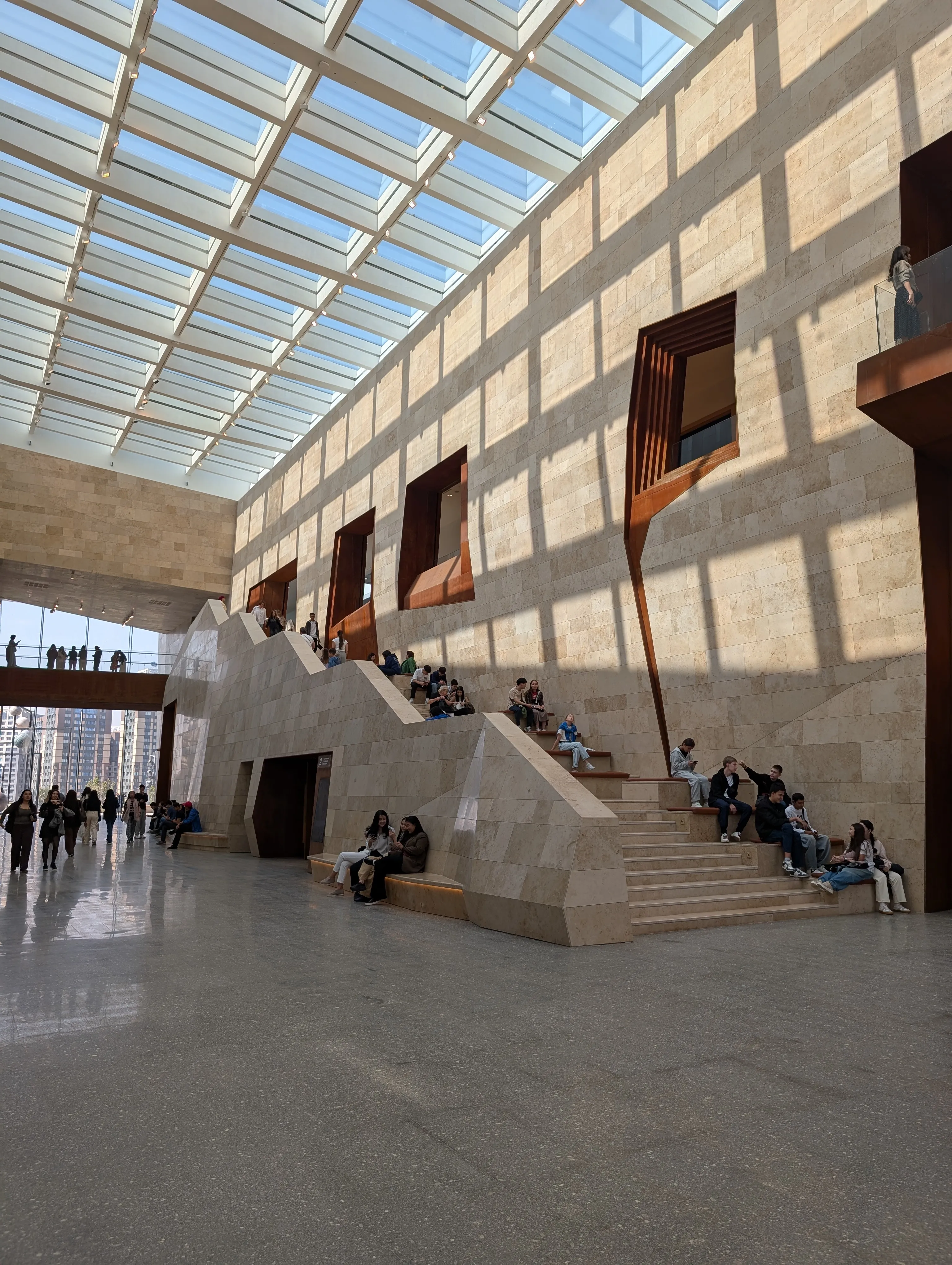
Tuesday to Sunday, 11:00 to 20:00, closed Mondays, last admission an hour before closing. 2,000 ₸ full, 500 ₸ reduced, from their own site on 27 August 2026.
Tselinny — a 1964 cinema, brought back
Tselinny was built in 1964 for the tenth anniversary of the Virgin Lands campaign, and was the largest cinema the Soviet Union built in Central Asia. It reopened in September 2025 as a centre for contemporary culture, rebuilt by the London architect Asif Khan with the Almaty architect Zaure Aitayeva — seismically strengthened, and returned to the spatial clarity it had to begin with.
If you only understand one thing about architecture in this city, make it the pairing on this page: a 1976 museum with a pyramid on it, and a 1964 cinema that a British architect spent years persuading back into use. The buildings people write about here are Soviet, and the city is now doing something with them rather than replacing them.
Tuesday to Sunday, 11:00 to 19:00, at Masanchi 59. Tickets are priced per event and some events are free, so check what is on before you go. There is no car park — take a taxi. There is a restaurant on the roof.
One thing worth planning around: they run mediations — guided walk-throughs of the exhibition — every weekday at 14:30 and 17:30, included in the ticket. Arrive ten minutes early. It is the difference between looking at contemporary art and understanding what you are looking at, and nobody charges extra for it.
How to actually split them up
One walk: the Museum of Almaty and Tselinny sit close enough to do on foot in the same outing, with the Kabanbay Batyr Julius on the way between them. Half an hour in the first, coffee, and as long as you like in the second.
Separate days: the Kasteyev and the National Central Museum are not on that walk — order a taxi for each — and the Almaty Museum of Arts deserves an afternoon by itself.
And check the day of the week before you set out. Mondays close nearly everything, Tuesday closes the National Central Museum, and the last day of the month closes the Kasteyev.
If it is the buildings you came for
Two of the five above are on this list as much for their architecture as their contents, and they are not the only buildings in Almaty worth standing in front of. The Soviet modernism the city still uses puts the Kasteyev and Tselinny alongside the hotel with the crown and the national library, with the dates and the architects.
Common questions
Which museums in Almaty are worth visiting?
Five, and not in one day: the Museum of Almaty for the city itself, the Kasteyev for Kazakh art, the National Central Museum for the country’s history, and two contemporary art institutions that both opened in September 2025 — the Almaty Museum of Arts and Tselinny.
Are Almaty’s museums closed on Mondays?
Most of them, but not all — and the exception catches people out. The National Central Museum closes on Tuesday instead. The Kasteyev also shuts on the last day of every month, whatever day that falls on.
How much do museums in Almaty cost?
Little. The Museum of Almaty charges 1,000 ₸ for residents and 1,500 ₸ for foreign visitors, the Almaty Museum of Arts 2,000 ₸, and the Kasteyev around 500 ₸. Tselinny prices per event and some of its events are free.
Is there contemporary art in Almaty?
Since September 2025, a great deal. The Almaty Museum of Arts opened on 12 September in a new building by Chapman Taylor, and Tselinny opened the same month in a 1964 cinema rebuilt by Asif Khan. Guidebooks written before that autumn do not have either.
Last updated .